Most CRM systems are good at storing information. They record contacts, opportunities, activities, emails and sales stages. But storing customer information is not the same as using it well.
Important context still gets scattered across inboxes, calendars, meeting notes, task lists and individual memories. Customers experience the consequences as repeated questions, slow follow-ups and conversations that lack continuity.
“The value of an Agentic CRM is not that it replaces customer relationships. It gives people more context and more time to strengthen them.”
From storing customer data to applying customer context
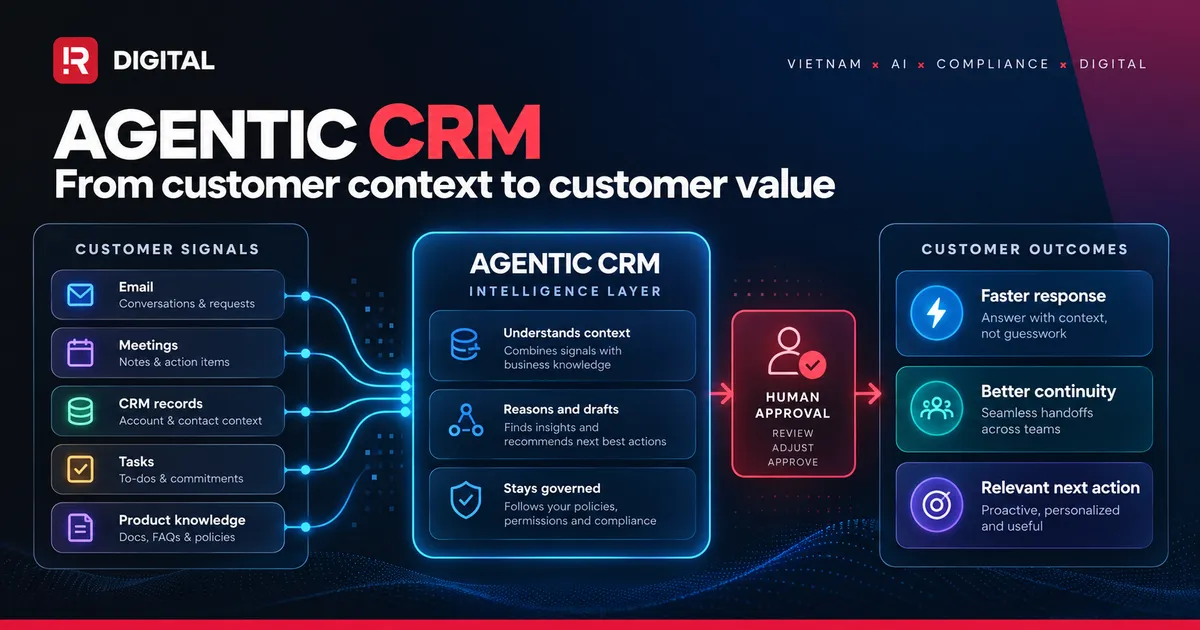
A conventional CRM waits for someone to open a record, interpret its history and decide what should happen next. An Agentic CRM can work continuously across the information a business already uses—customer records, email, meetings, tasks, support history, product knowledge and approved external research.
It can recognize when a customer is waiting for promised information, an opportunity lacks a next action, a partner relationship needs attention or several colleagues are engaging with the same account without a shared view. The outcome is not simply better data. It is better continuity for the customer.
Faster, more relevant responses
Customers care whether a business understands their situation and responds effectively. An Agentic CRM can assemble the relevant context before a conversation, summarize recent activity, surface commitments and prepare a suggested next step.
A salesperson can enter a meeting with a concise account brief instead of searching through multiple systems. A customer-success team can see unresolved actions before making contact. The agent may prepare a follow-up email, agenda or proposal outline, while the responsible person reviews and approves it before anything is sent.
“Customers should not have to repeat their story because a business has failed to connect its own information.”
More consistent customer journeys
Customer experience often varies according to who owns the relationship. Agentic workflows can make good practices repeatable without making every interaction identical. The CRM can recommend next actions based on the customer, relationship stage and previous activity; remind teams about commitments; and highlight missing information before it becomes a problem.
The same context can follow the customer from sales into implementation, support and account management: objectives, requirements, stakeholders, risks, commitments and unresolved questions. That creates cleaner handovers and reduces the gap between what was sold and what must be delivered.
Proactive service instead of reactive administration
Traditional CRM activity often begins after somebody remembers to check the system. Scheduled agents can review upcoming meetings, overdue tasks, inactive opportunities and recent communications, then prepare a daily briefing with the relationships that need attention.
- Customers who need a response today.
- Meetings that require preparation.
- Promised actions that are overdue.
- Opportunities without a meaningful next step.
- Relationships that may be losing momentum.
The CRM becomes a system that helps organize the working day. For customers, that means fewer dropped commitments and more timely communication.
Better preparation without generic communication
AI creates impersonal outreach when it is used primarily to increase message volume. A well-designed Agentic CRM does the opposite: it grounds suggestions in verified customer context so communication becomes more relevant. Drafts remain drafts until reviewed; suggested changes stay visible; important actions require approval and leave an audit trail.
“Good agentic systems automate preparation and coordination—not trust, accountability or human judgment.”
What makes an Agentic CRM trustworthy?
An Agentic CRM works with commercially and personally sensitive information. Its architecture matters as much as its intelligence. A trustworthy implementation includes:
- Clear permissions for users and agents.
- Human approval for consequential actions.
- Audit logs for suggestions and completed changes.
- Data minimization and controlled retention.
- Secure, narrowly scoped integrations.
- Verified sources for customer and product information.
- Explicit rules for outbound communication.
- Appropriate self-hosting or data-control options.
Start with a customer outcome
The best starting question is not “Where can we add AI?” Begin with a customer-facing problem: slow follow-up, poor meeting preparation, lost handover context, stalled opportunities or inconsistent proposals. Then identify the information, decisions and workflows needed to improve that outcome.
The CRM is becoming more than a system of record. Thoughtfully designed, it becomes a system for coordinating customer value—connecting context, recognizing what needs attention and helping people take the right action at the right time.
Build an Agentic CRM around your customer journey
R Digital designs and builds custom Agentic CRM systems that connect customer context, commercial workflows, integrations and governed AI agents.
Talk to R Digital about Agentic CRM →